Plastic Wildlife of the American Front Yard: A 2026 Field Guide to Flamingos, Geese, and One Very Committed Dragon
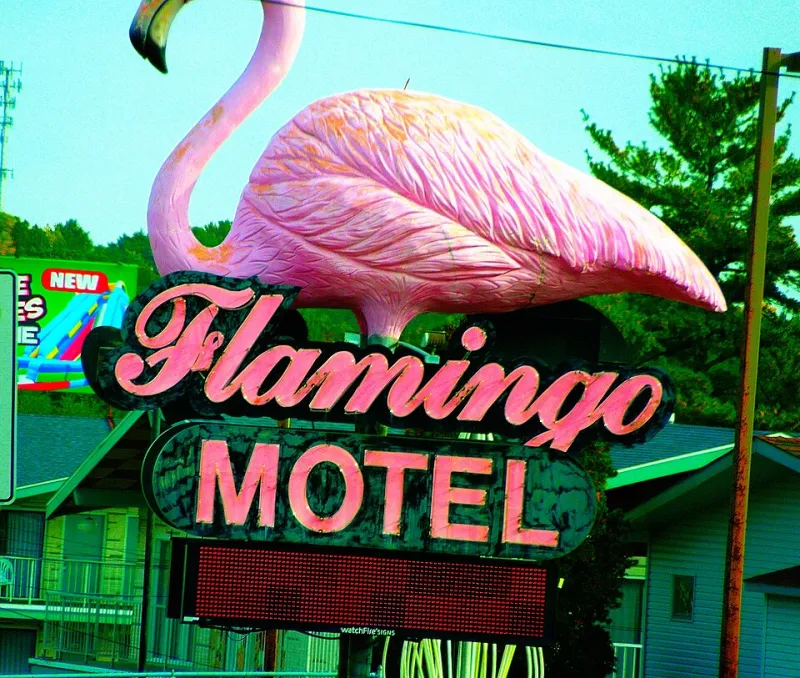
Photo: Corey Coyle, CC BY 3.0, via Wikimedia Commons
America’s front yards are a museum with no curator, no admission fee, and a gift shop that is basically the neighbor’s garage sale. In 2026, the great lawn-ornament conversation is still going, even if nobody officially scheduled it. The plastic pink flamingo — born in 1957, thanks to a Massachusetts plastics company — remains the mascot. But around it has grown a whole ecosystem: inflatable dragons, concrete geese in rain bonnets, solar-powered gnomes, and at least one plywood Bigfoot that appears to be judging your mulch.
At Kyj Kyj, we are not scientists. We are, however, people who have driven slowly past a yard containing both a Virgin Mary statue and a six-foot inflatable T-rex. That counts as fieldwork.
The Bird Is Still the Word
The flamingo never really left. It just got company. The classic pink bird still signals a certain looseness of spirit — a homeowner who is not going to apologize for joy. But in 2026, the lawn-ornament aisle has splintered into tribes. There are the holiday maximalists, the sports shrines, the fairy-garden miniaturists, and the people who own exactly one massive inflatable dragon and rotate it like a seasonal exhibit at the Met.
One collector in central Florida, who asked to be identified only as ‘the woman with 43 flamingos,’ says the trick is commitment. ‘You can’t have one flamingo and call it a theme,’ she told us. ‘That’s just a bird in a yard.’ Her display includes flamingos in Santa hats, flamingos in graduation caps, and a flamingo wearing a tiny vest for no reason she could recall. It is, by any reasonable standard, a lifestyle.
A Field Guide to Front-Yard Personalities
After months of highly unofficial observation, certain types keep showing up.
The Seasonal Tailgater. This is the yard with a concrete goose dressed for every occasion: Easter bunny ears, Fourth of July scarf, back-to-school backpack, Halloween witch hat. The goose is not decorative. The goose is a calendar.
The Minimalist Maximalist. One object, but it is enormous. A twelve-foot dragon. A inflatable snowman that could block radar. The message is clear: I did not decorate; I commissioned.
The Folk-Art Accumulator. Bottle trees, pinwheels, painted bowling balls, a hubcap flower. This yard has the energy of a roadside attraction that decided to settle down.
The Sports Shrine. Team flags, a inflatable football player, a mailbox painted in school colors. In September, it becomes a civic institution. In January, it becomes a cautionary tale about hope.
The Cryptid Curator. Bigfoot cutouts, UFO signs, a lawn gnome that has been zip-tied to a fence for reasons unknown. These yards are not weird. They are asking questions.
The Memorial Gardener. Angel statues, flags, solar lights, a bench nobody sits on but everybody respects. This is the category that sneaks up on you. It is not a joke. It is a front-yard obituary, and it is often the most moving thing on the block.
When the HOA Comes Knocking
Lawn ornaments are personal, but they are also public. That means code enforcement gets involved. Most small-town ordinances are not anti-flamingo. They are anti-clutter, anti-visibility-hazard, and anti-inflatable-left-up-until-July. A code officer in suburban Dallas told us the calls usually start after a storm. ‘A deflated dragon looks like a tarp,’ she said. ‘Then someone complains about a tarp. Then we have to explain that it is not a tarp. It is a dragon having a bad week.’
Some towns have rules about how long seasonal inflatables can stay up. Others care about sight lines at intersections. Very few have a specific flamingo clause, which is probably for the best. A flamingo clause sounds like the beginning of a very strange Supreme Court case.
The Displays That Got Us
We are not ranking these by price or square footage. We are ranking them by the feeling they leave you with — that small, unexpected ache that says somebody cared about this patch of grass more than they had to.
1. The Grandma Goose Memorial in Minnesota. A concrete goose in a raincoat and gardening hat, surrounded by hand-painted stones. Neighbors add notes on bad days. It started as a joke. It became a mailbox for feelings.
2. The Driveway Dragon of Oregon. A twelve-foot inflatable dragon that ‘guards’ a Little Free Library. Kids leave books for it. Adults take photos. The dragon has done more community outreach than most committees.
3. The Bottle-Tree Block in Mississippi. Forty blue bottle trees in a row, each one dedicated to a family member. In late afternoon light, it looks like a stained-glass window that learned to stand up.
4. The Tiny Parking Lot in Pennsylvania. A patch of pavement with matchbox cars neatly parked in spaces. A sign reads ‘RESERVED.’ The owner told us it was for the neighborhood kids. The kids take it very seriously. So do we.
How to Read a Block
A front yard is never just a front yard. It is a press release. It says: I am proud of my team, I miss my mom, I believe in dragons, I have given up on mowing. The plastic flamingo is not an eyesore. It is a handshake.
So the next time you walk past a goose in a raincoat or a inflatable T-rex wearing a birthday hat, do not judge. Read the room. America’s weirdest census is happening every day, and the only question is whether your block is keeping up.